

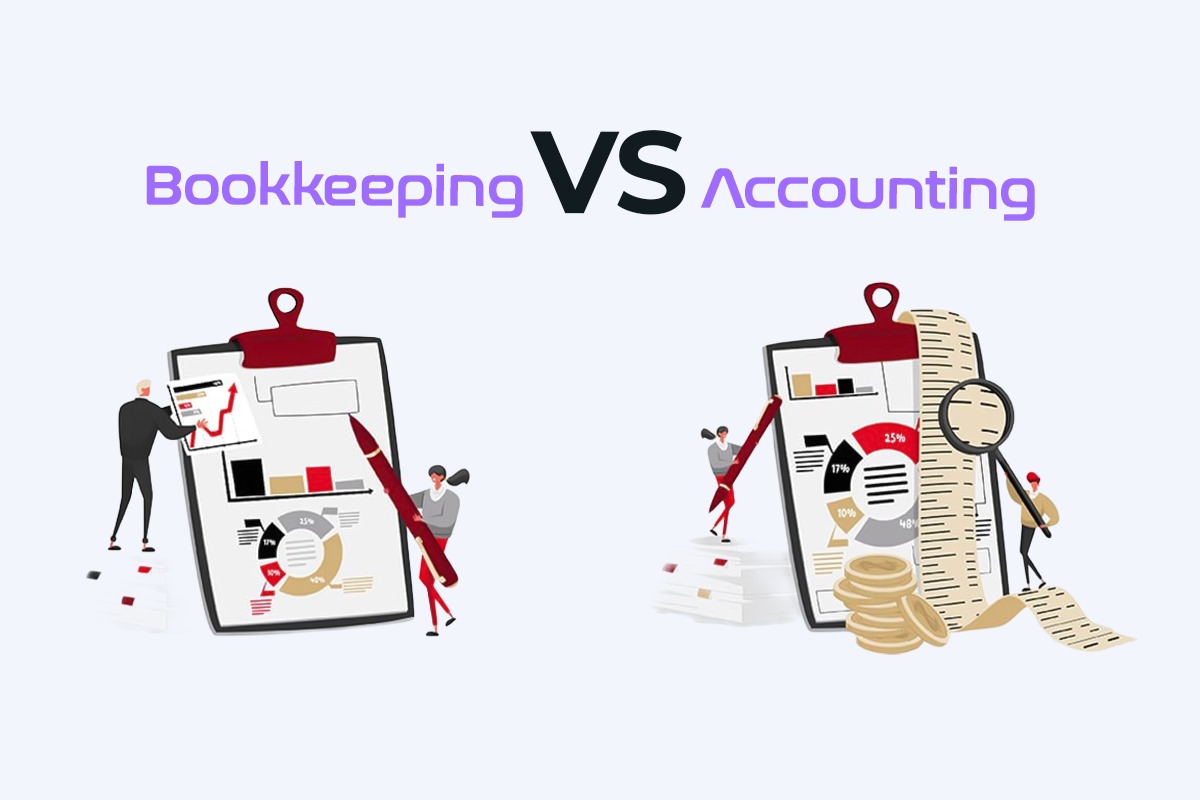
As an entrepreneur, you have probably asked yourself: “I need accurate numbers for taxes or funding, but who does what—my bookkeeper or my accountant?” This confusion is common, especially when terms like bookkeeping vs accounting, accounting vs bookkeeping for small business, and even bookkeeping vs accountancy get tossed around interchangeably.
Here’s the reality: while bookkeeping and accounting are closely linked, they serve very different purposes. Competitors describe it in different ways—Bench calls it “different stages of the financial cycle,” QuickBooks says “Bookkeeping = record & reconcile; Accounting = analyze & advise,” while Target Accounting frames it as “an entrepreneur’s lens on responsibilities and outcomes.”
In this guide, you’ll get crisp definitions, clear role boundaries, and real-world cases where you need one, the other, or both. By the end, you’ll know exactly how bookkeeping vs accounting fits into your business growth strategy.
Definitions You Can’t Mix Up
So, what is bookkeeping vs accounting in simple terms?
Bookkeeping is the systematic, day-to-day recording and organizing of your business transactions—sales, bills, payroll, and bank feeds. Think of it as maintaining a clean, categorized log of all financial activity. Bench and QuickBooks both agree on this scope: bookkeepers keep your data current and reconciled.
Accounting on the other hand, goes a step further. It involves interpreting, adjusting, and reporting that financial data. Accountants make financial reports, plan taxation strategy, ensure regulatory compliance, and take part in forecasting. Intuit and QuickBooks make accounting to be part of the accounting level of relying on bookkeeping as the foundation.
Key takeaway: Bookkeeping constructs the dataset and accounting converts it into knowledge and strategy. That is the essence of the difference between how is bookkeeping and accounting are done.
The Financial Cycle: Where Each Role Fits
So that we can comprehend the distinction between bookkeeping and accounting, we need to take a look at the financial cycle:
Transaction- Washed > Capture > Categorize > Reconcile > Adjust > Report > Plan
Bookkeepers do the former half: they record transactions, classify transactions and balance accounts. Accountants are brought in during adjustment stage, reporting, and planning stages of the process, contributing a context, compliance and strategy. That is how it is in practice, as Bench puts it, these are the different stages of the cycle.
For example:
- Your bookkeeper includes a supplier bill, includes it in the expense column and reconciling it with your bank.
- Your accountant later adjusts entries for accruals, prepares your tax-ready statements, and advises on cash-flow planning.
This “handoff” is where many entrepreneurs get stuck. But once you see the cycle end-to-end, it’s clear why bookkeeping vs accounting vs auditing (a separate function) all serve unique roles.
Bookkeeping vs Accounting: A Direct Comparison
| Aspect | Bookkeeping | Accounting |
| Purpose | Records day-to-day financial transactions | Analyzes and interprets financial data |
| Skills Required | Basic financial knowledge, accuracy | Analytical skills, financial expertise |
| Output | Ledgers, journals, trial balances | Financial statements, tax filings, forecasts |
| Decision-Making | Provides raw data | Provides insights for decisions |
| Tools | Spreadsheets, bookkeeping software | Accounting software, ERP systems |
This clears the common confusion around book keeping vs accounting or even book keeping vs accountancy—they are connected but not the same.
Responsibilities, Side-by-Side
Here’s how the core tasks break down when comparing bookkeeping vs accounting:
Bookkeepers typically handle:
- Accounts payable/receivable
- Bank feeds & reconciliations
- Payroll entries
- Receipt and expense tracking
- Month-end checklists
- Trial balance preparation
Accountants typically handle:
- Adjusting entries (accruals, depreciation)
- Management and financial reports
- Tax planning & filings
- KPI dashboards
- Forecasting and scenario modeling
Full-Charge Bookkeeper vs. Accountant — Where Responsibilities Overlap
The issue of full charge bookkeeper versus accountant here is that a full-charge bookkeeper can be trusted to do the whole bookkeeping process on his or her own, yet an accountant still does the much greater tweaks, compliance and top level high-level reporting.
H4: Pro Tip: A side by side comparison table helps provide clarity on those differences between both book keeping and accounting to your team or to your partners.
Deliverables You Should Expect
When hiring, you’re not just paying for tasks—you’re paying for deliverables. Here’s what that looks like in book keeping vs accounting:
From Bookkeepers, expect:
- Up-to-date ledgers
- Reconciled accounts
- AR/AP aging reports
- Basic profit & loss and balance sheet
- A clear audit trail
From Accountants, expect:
- Management packs (P&L, Balance Sheet, Cash Flow)
- Variance analyses
- Tax computations and returns
- Forecasts and board-ready summaries
Competitors often gloss over this difference. But clarity here matters: bookkeepers deliver data accuracy weekly or monthly, while accountants deliver insights quarterly or annually. If you’re evaluating booking vs accounting services for your small business, always ask about deliverables upfront.
Tooling & How It Shapes the Roles
Software can blur the bookkeeping vs accounting debate, but it doesn’t erase the differences.
Cloud tools like QuickBooks, Xero, FreshBooks, and Zoho automate data capture, bank feeds, and reconciliations. This helps bookkeepers work faster and more accurately, while giving accountants cleaner data for analysis. For example:
- Bookkeeper benefit: auto-categorization of expenses.
- Accountant benefit: instant access to cash-flow dashboards.
Then there’s the “service + software” model. Bench offers bookkeeping as a service with built-in software, while QuickBooks sells software plus optional “Live Bookkeeping.” The key point? Software ≠ service. A program can record transactions, but it won’t analyze tax strategy or give tailored advice.
Actionable tip: Choose your stack based on your business size and complexity. Micro-businesses might get by with QuickBooks alone, while growth-stage firms benefit from a bookkeeper and accountant working together.
Compliance & Tax: Who’s on the Hook?
Here’s where accountability really matters in the difference between bookkeeping and accounting.
- Bookkeepers: keep clean substantiation and audit trails, categorize tax-sensitive transactions correctly, and prepare schedules.
- Accountants: finalize adjustments, sign off on filings, and ensure compliance with corporate tax, payroll tax, or sales tax (VAT/GST depending on jurisdiction).
This is where confusion often arises—entrepreneurs assume bookkeepers file taxes, but in reality, it’s the accountant’s role to ensure regulatory compliance. Bookkeepers prepare; accountants finalize.
Competitors sometimes blur these lines, but by making them explicit, you can better protect your business from costly compliance mistakes.
Cost, Cadence & Engagement Models
Understanding the cost and cadence of bookkeeping vs accounting is crucial for entrepreneurs.
- Bookkeeping: Typically involves weekly transaction recording, invoice tracking, and a monthly close.
- Accounting: Usually runs on a monthly or quarterly reporting cadence, with tax filings and compliance checks annually.
Cost drivers vary depending on transaction volume, payroll size, number of business entities, inventory or ecommerce complexity, and whether you need catch-up bookkeeping. For example:
- A freelancer with under 50 transactions/month may only need a virtual bookkeeper a few hours monthly.
- A small retail business with payroll and inventory will need both regular bookkeeping and accounting support.
- A scaling startup with investors will require accountants for cash-flow forecasting and board reporting.
Competitors often gloss over this level of detail. By highlighting scoping factors, you can confidently decide if you need basic bookkeeping services or a more robust accounting vs bookkeeping for small business package.
When You Need a Bookkeeper, an Accountant—or Both
Still debating what is bookkeeping vs accounting and who to hire? Use this simple decision tree:
- Hire a bookkeeper if: you’re falling behind on reconciliations, unpaid invoices are piling up, or you’re stuck managing spreadsheets manually.
- Hire an accountant if: lenders or investors demand financial statements, you need tax planning, forecasting, or entity restructuring.
- Hire both if: your business is growing, hiring staff, managing inventory, or preparing for fundraising.
Bench and QuickBooks both hint at this division, but few provide a direct yes/no flow. For entrepreneurs in Pakistan and beyond, the decision often isn’t book keeping vs accounting—it’s knowing when to combine them.
KPIs Each Role Owns
Turning roles into outcomes clarifies how is bookkeeping different from accounting.
Bookkeeper KPIs:
- Timeliness of month-end close
- Number of unreconciled items
- Accuracy of AR/AP aging reports
- Receipt capture and categorization rate
Accountant KPIs:
- Gross margin trend
- Operating cash flow
- Budget vs actual variance
- Effective tax rate
These metrics keep both bookkeepers and accountants accountable—not just for tasks, but for measurable business impact. It’s a competitor gap most guides on book keeping vs accountancy don’t address.
Industry Nuances
The difference between bookkeeping and accounting shifts slightly by industry:

- eCommerce: bookkeepers handle inventory and cost of goods sold, while accountants adjust for deferred revenue and tax complexities.
- SaaS startups: bookkeepers manage subscription billing; accountants ensure proper recognition of deferred income.
- Professional services: bookkeepers track billable hours; accountants model profitability by project.
- Nonprofits: bookkeepers record donations and grants, while accountants ensure compliance with fund accounting rules.
QuickBooks covers roles broadly, but adding industry color highlights why one-size-fits-all rarely works in bookkeeping vs accounting vs auditing.
Career Tracks & Credentials
For trust, entrepreneurs need to know who they’re hiring.
- Bookkeepers: Skilled in reconciliations, accounts payable/receivable, and payroll. Credentials may include certifications like QuickBooks ProAdvisor or Xero Certification.
- Accountants: Master GAAP/IFRS, tax laws, and strategic planning. Credentials often include CPA (Certified Public Accountant), CA (Chartered Accountant), or equivalent.
QuickBooks provides career comparisons, but adding credential paths builds clarity when evaluating full charge bookkeeper vs accountant candidates.
Common Misconceptions to Bust
A few myths make book keeping vs accounting confusing:
- “Software replaces bookkeepers or accountants.” Tools automate tasks, but judgment and compliance still require humans.
- “My accountant can just fix things at year-end.” Incorrect—unclean books mean expensive cleanup later.
- “Bookkeeping and accounting are the same.” They serve different stages of the financial cycle.
Bench and Target Accounting touch on these, but few call them out directly. Busting myths helps small business owners avoid costly mistakes.
How to Implement the Right Mix in 30 days: A Quick Plan
Here’s a practical action plan competitor rarely provide:
- Week 1: Choose software (QuickBooks, Xero), set up your chart of accounts, connect bank feeds.
- Week 2: Clean AR/AP, standardize categories, implement receipt capture (like Dext or Hubdoc).
- Week 3: Create a monthly close checklist; define a simple KPI dashboard.
- Week 4: Have your accountant review, finalize management reports, and set a tax calendar.
This 30-day roadmap bridges the manual tender process vs e tender process-style debates by showing you exactly how to put bookkeeping vs accounting into practice.
Conclusion
At the end of the day, bookkeeping vs accounting isn’t about choosing one over the other—it’s about understanding their partnership. Bookkeeping ensures your numbers are clean and current. Accounting transforms those numbers into compliance, strategy, and growth decisions.
Ready to stop guessing between bookkeeping vs accounting for small business? Start with a monthly close checklist and book a discovery call to scope the right mix of bookkeeping services and accounting support for your business.
H2: FAQs
- Is bookkeeping the same as accounting?
No—bookkeeping records data; accounting interprets and advises. - Can one person do both?
Yes, in very small businesses, but separation improves accuracy and control. - Do I need an accountant if I use QuickBooks?
Yes—software automates entry but doesn’t handle tax strategy or compliance. - How often should I update books?
Process transactions weekly, close books monthly. - What documents do I keep for tax?
Invoices, receipts, payroll, and bank statements (accountant will confirm exact requirements.
