

In today’s competitive business environment, financial data isn’t just numbers in a spreadsheet it’s a roadmap for growth, risk management, and long-term success. For companies in Pakistan, a financial analysis report is a fundamental tool that turns raw data into meaningful insights, helping leaders make informed decisions and stakeholders understand a company’s financial condition.
In this guide, we will explore what financial analysis reports are, introduction to financial reporting and why they matter, how they are created, what they include, and how they support decision-making for businesses in Pakistan especially within the frameworks of financial reporting and analysis and international financial reporting standards (IFRS).
What Is Financial Reporting and Analysis?
Financial reporting is in essence the process of organizing and reporting the activities of a company in the form of structured financial statements, i.e., balance sheets, income statements, etc. These summaries are summary performance and financial position statements that are understandable and transparent.
Financial analysis, however, goes one step further. It analyses data available in these reports to analyze the performance of the business, trends, and future. Financial reporting along with financial analysis combined explain what, why, and what will happen in the future.
Financial analysis report integrates these aspects into a complex report which evaluates the profitability, liquidity, and the general financial wellbeing of the business and by extension, the business owners, investors, lenders, and even regulators.
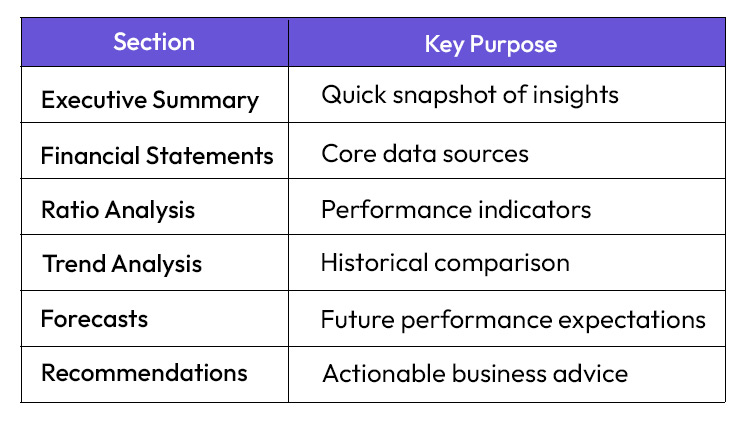
Essential Elements of an Advanced Financial Reporting Analysis
Why Financial Analysis Reports Matter for Businesses in Pakistan
Professional bookkeeping of assets and liabilities with clarity and accuracy of financial visibility that gives a sound idea of profitability, expenses, and income, and therefore, business decisions are easier and more informed.
• Waste Less Time and More on Important Work
The work of maintaining the financial records is avoided because of outsourced services or dedicated services and you are free to concentrate on the growth, customer satisfaction and strategic planning.
• Efficient Financial Management
It can also make financial management more cost-effective than recruiting a full-time employee because it will lessen the overheads such as salaries, benefits, and investment in software.
• Accountant Advice and Tax compliance
The seasoned accountants are knowledgeable about the legislation and financial rules that can guide you to avoid taxes, keep within the rules, and utilize the legal tax-reduction guidelines.
• Better Reporting and Decision-Making
There is an understanding of cash flow, better budgeting, tracking of trends and future growth planning with reasonable confidence due to regular financial reports.
• Attracts Investment and Financing
The online accounting and bookkeeping services frequently utilize cloud-based technology to automate operations and give you direct access to your financial information in real-time.
Explore more in-depth guides on financial services our website for instance if you want to know about the difference between accounting and bookkeeping services.
Key Components of a Financial Analysis Report For Companies
A Power pact financial analysis report includes several essential sections:
1. Executive Summary
This is a concise overview of findings highlighting key performance metrics, trends observed, and conclusions drawn from the financial analysis.
2. Company Profile and Business Context
This section introduces the business, its industry, size, ownership structure, and key activities — setting the context for the analysis that follows.
3. Financial Statements Reviewed
Primary financial statements include:
- Balance Sheet
- Income Statement
- Cash Flow Statement
- Statement of Changes in Equity
These statements form the foundation of both reporting and analysis.
4. Ratio and Trend Analysis
Financial ratios help assess performance across areas like profitability, liquidity, and leverage:
| Analysis Category | Example Ratios | Purpose |
| Profitability | Net Profit Margin, Return on Equity | Shows how effectively profits are being generated |
| Liquidity | Current Ratio, Quick Ratio | Assesses ability to meet short-term obligations |
| Leverage | Debt-to-Equity Ratio | Measures financial risk and capital structure |
| Efficiency | Inventory Turnover | Indicates how well assets support operations |
These ratios are used to compare performance over time (trend analysis) and industry benchmarks. Contact Finance Ora from financial analysis report services to complete audit for your bussiness today!
5. Interpretation of Results
This section explains what the numbers mean for example, whether sales growth is strong, profit margins are shrinking, or cash flow is adequate to support operations.
6. Forecasts and Projections
Based on historical trends and market conditions, this part projects future performance a crucial step in budgeting and strategic planning.
7. Risk Assessment and Recommendations
Here, analysts highlight financial risks (like liquidity issues or high debt levels) and provide actionable suggestions to improve performance.
How to Write a Financial Report Analysis: Step-by-Step Process
The following structure helps to analyse and interpret financial reports in writing a financial statement analysis report like professional:
Step 1: Purpose and Scope
Explain clearly the purpose of preparing the analysis, and the period of time or business units your analysis will address.
Step 2: Collect Relevant Data
Assemble the financial statements and make sure that they are full and balanced. Included should be the annual report last year and interim reports where possible.
Step 3: Analyze Key Metrics
Interpret the financial status of the company using use ratio analysis, trend analysis and cash flow evaluation. Compare data on an annual basis to detect patterns and unusual situations.
Step 4: Draft Interpretations
The annual report financial statements not only what the numbers are, but why it is important, explain what the analysis shows.
Step 5: Recommendations
Give viable financial recommendations on the basis of your analysis like enhancing the cost efficiency or enhancing liquidity.
Step 6: Summarize Insights
Conclude with a concise summary of the financial position, the risks, and opportunities of the company. You can use the following Financial Reporting and Analysis template here.
Importance Financial Reporting and Analysis in the Pakistan
Pakistan’s annual report and financial statements landscape operates within global standards adapted to local laws. The International Financial Reporting Standards (IFRS) are required for many domestic companies preparing statutory financial statements especially publicly traded and large-scale businesses under the Companies Act 2017.
Compliance financial reporting and analysis book with IFRS ensures that financial statements are reliable, comparable, and transparent not only domestically but also for international stakeholders. Companies that adhere to these standards are better positioned to attract foreign investment and participate in global markets.
Difference between Financial Reporting and Financial Statements
| Aspect | Financial Statements | Financial Reporting |
| Purpose | Document financial activities | Interpret financial data |
| Output | Financial statements and disclosures | Insights, ratios, trends |
| Focus | Accuracy and compliance | Strategic decision-making |
| Users | Auditors, regulators, investors | Management, investors |
Financial report of Pakistan lays the foundation by presenting what happened when financial analysis builds on that foundation to explain why it happened and how it impacts the business.
Benefits of Financial Reporting and Analysis Services for Bussinesses
Many companies choose to hire professional financial reporting and analysis services to ensure accuracy, insight, and strategic clarity. These services offer a wide range of advantages for businesses of all sizes:
• Better Financial Control and Cash Flow Management: Frequent financial reporting and evaluation enables businesses to manage cash flow in more detail, manage working capital in a more efficient manner and control expenses in a manner that makes them more operationally disciplined. This results in improved budgeting and cash planning.
• Improved Decision-Making and Strategic Planning: Using financial information and tools such as ratio and trend analysis, professional services can enable business leaders to make data-driven decisions regarding investments, expansions, pricing and cost management, based on objective performance data, and not on guesswork.
• Higher Transparency and Stakeholder Confidence: Due to the financial reports that are completed properly and on time, transparency and accountability are achieved and trust is built with the investors, lenders and partners. This enhanced credibility may facilitate easier capture of capital and bargaining of funds.
• Risk Identification and Management: Financial analysis assists in identifying early signals of financial stress (e.g., liquidity position or excessive leverage) before it can be corrected, so that businesses can make proactive measures to reduce such risks before they occur.
• Efficiency and Concentration on Value-Added Activities: Outsourcing or using professional reporting tools enables the internal teams to concentrate less on data collection and more on results interpretation, performance improvement and strategic planning. This processing to analysis increases efficiency in operation.
Whether done in-house or through specialists, financial reporting and analysis amplifies business intelligence and financial clarity.
Conclusion: Financial Analysis Reports Matter
The financial analysis reports are invaluable assets to businesses and companies in Pakistan – turning the raw financial data into actionable information to enhance better planning, risk management, compliance and growth. Being a startup, SME, or an established company, the better position you are placed to achieve success in the modern market is to have knowledge on the role and structure of financial analysis reports.
The adoption of financial reporting and analysis, companies not only adhere to the regulation standards, but also they are in a better position to make smarter and more strategic decisions that drive them forward.
Get a free financial analysis consultation with Finance Ora explore insights to grow your business today.
FAQs About Financial Analysis Reports
1. What is a financial analysis report?
Financial analysis report is the financial analysis of a company, which is conducted through analyzing the annual financial report template of a firm to facilitate decision making and reporting to stakeholders.
2. What should I Prefer financial reporting or financial analysis?
Financial statement report shows organized financial statements whereas financial analysis explains the statements so as to provide enlightenment on performance, trends and risk.
3. What is the relevance of financial analysis to the businesses in Pakistan?
It allows making decisions based on data, makes compliance with reporting standards, such as IFRS, more effective financial statement audit report, and enhances transparency and investor confidence.
4. What is the procedure of writing a financial feasibility report?
Begin company financial report with the data collection, calculate important metrics, prepare interpretations (first draft), provide recommendations, and conclude (write brief summaries) in an organized fashion.
5. What are common financial statements included in analysis?
Balance sheets, income statements, and cash flow statements are foundational for performance evaluation and forecasting. You can also checkout financial report template excel has on their website.
