

Have you ever processed payroll, hit the “send” button and then realized something just didn’t look right? Maybe an overtime rate was off, or a deduction was missing. You are definitely not alone. In fact, most businesses make payroll errors more often than you might think.
These errors aren’t just minor annoyances, they affect your employees’ trust, your bottom line, and potentially your legal compliance. Whether you’re a small business juggling everything yourself, or a growing organization considering payroll outsourcing, getting payroll right is crucial.
In this guide, we will walk through the most common payroll mistakes, why they happen, and how you can correct payroll errors and ideally prevent them altogether.
Why Payroll Mistakes Happen
Let’s be honest payroll is tricky. It’s not just pushing a button; it involves accurate data, correct classifications, timely filings, and keeping up with compliance. Here are some of the main reasons payroll mistakes creep in:
- Manual processes and human error: When you are entering hours, deductions, tax codes manually, one simple typo or oversight can trigger a cascade of issues.
- Outdated or inadequate systems: If your payroll system doesn’t integrate with your time‑tracking, HR or tax updates, you are at risk of mismatches and inaccuracies.
- Employee misclassification & changing roles: Mix‑ups happen especially when employees move roles, the nature of work changes, or you engage contractors alongside employees. Misclassifying someone as a contractor instead of an employee affects tax, benefits, overtime.
- Compliance, regulation & regional differences: Labor laws, tax rules, benefit schemes, they differ across regions, and they change. If you are operating in emerging markets, or handling remote/international staff, you will need to keep up.
- Lack of documented process or audit culture: If every payroll run is a “just get it done” exercise without a structured checklist, approvals or review, odds of error go up. One resource noted that while payroll is often seen as “back‑office”, it needs to be treated as strategic.
The Most Common Payroll Mistakes and How to Fix Them
Here we will break down typical errors, why they happen, and exactly what you can do to correct them, whether you are handling things in‑house or leveraging payroll services.
1. Misclassifying Employees
One of the most frequent payroll errors is categorizing a worker incorrectly‑for instance, as a contractor instead of an employee, or as exempt vs non‑exempt. This misclassification leads to incorrect tax withholding, benefit entitlements and overtime handling.
How to fix it:
- Review every role: contractor vs employee, full‑time vs part‑time, exempt vs non‑exempt.
- Update your internal document for each worker’s classification and keep signed agreements.
- If you’re using payroll outsourcing, ensure your partner has local/regional‑classification expertise (especially important in Pakistan where definitions might differ).
- Set an annual audit of classifications so nothing slips through.
2. Miscalculating Wages, Leave, Overtime or Deductions
Calculation errors are a huge category of common payroll mistakes like wrong pay rate, missed bonuses, incorrect leave accrual, deductions omitted or mis‑calculated. In fact, one statistic states that the average company makes about 15 errors per payroll period.
How to fix it:
- Use integrated time‑&‑attendance systems feeding into payroll to reduce manual entry.
- Set up rule‑based checks: e.g., overtime > X hours must be approved, deductions flagged.
- For the Pakistan/emerging‑market context: ensure your system understands local leave rules, statutory deductions and currency/local benefits.
- If you outsource or use payroll services, pick one with strong local compliance and built‑in error‑checking.
3. Missing Deadlines & Late Payroll Runs
Nothing undermines trust faster than staff not being paid on time. Late payroll runs, tax filings or benefits submissions create huge ripple effects. According to one survey, over 90% of UK businesses admit making payroll errors monthly, many due to late deadlines.
How to fix it:
- Create a fixed calendar for payroll triggers: data cut‑off, running payroll, tax/filing due dates.
- Automate reminders and set ownership for each date.
- For emerging markets like Pakistan: ensure you map local statutory deadlines (tax, pension, labor boards) into the calendar.
- If you’re using payroll outsourcing, check they commit to SLA turnaround times and local compliance tracking.
4. Incorrect or Outdated Employee Data
Another category of payroll errors comes from employee data that’s incorrect or outdated (name, address, tax ID, bank details). One research shows the average payroll accuracy rate is about 80%—meaning nearly 1 in 5 payrolls contains an error.
How to fix it:
- Maintain a centralized master‑employee file with version control and audit trail.
- At every onboarding, update personal details, tax status, bank info. At off boarding, ensure final run includes termination pay/settlements.
- Use software or payroll management platforms that enforce mandatory fields and validate data (especially important in markets with multiple tax regimes).
- If outsourcing, ensure your provider syncs with your HR system and performs data reconciliation before each pay run.
5. Using Inadequate or Outdated Payroll Systems
Many common payroll mistakes stem from relying on spreadsheets, siloes systems, or software that doesn’t integrate with HR/time or doesn’t update for compliance changes. One study said correcting each payroll error costs an average of US $291.
How to fix it:
- Evaluate whether your current system supports automation, integration (HR, time, benefits) and local compliance (tax, labour law).
- If you are growing or operating across regions (like Pakistan and other countries), pick a system or payroll services provider that supports multi‑jurisdiction features.
- Consider the ROI: fewer errors mean less correction costs and better trust with some fewer compliance fines.
- If you outsource payroll, vet your provider’s technology stack and ask for proof of accuracy/SLAs.
6. Regional/Local Compliance Errors
If you are operating in Pakistan or other emerging markets, local regulation, tax law, labour benefits, currency / multi‑currency payroll bring extra complexity. Many payroll mistakes happen because the system or process wasn’t adapted for local rules. For example, one global survey found younger workers were more likely to experience payroll errors and that global/local differences matter.
How to fix it:
- Conduct a local regulatory review: tax withholding, national insurance/social security, labour law, annual leave, statutory benefits.
- Check whether your payroll software or provider is conversant with Pakistan’s rules and local practices (for example, local bank settlement times, statutory bonus, local deduction types).
- Use payroll outsourcing or payroll services with a local team/infrastructure.
- Periodically audit your local payroll runs for compliance and accuracy and compare with benchmarks/industry.
7. Lack of Process, Review or Audit Culture
When payroll is treated as “just a task”, without documented process, reviews or audits, errors become routine. According to some data, many payroll mistakes are found by employees rather than internal checks.
How to fix it:
- Develop a documented payroll policy: deadlines, roles/responsibilities, classification rules, audit process.
- Implement a pre‑payroll checklist: data review, approvals, reconciliation.
- Conduct periodic audits (quarterly or at least annually) and track error trends.
- Whether you manage payroll in‑house or via payroll outsourcing, ensure the provider follows a clear audit protocol and shares error/issue reports with you.
Your Payroll Mistake Prevention Toolkit
Here’s a tool you can use over and over whether you run payroll in‑house, use payroll services, or work with a partner for payroll outsourcing. Each payroll run and quarterly both you should check:
- Audit your payroll process: look for recurring errors or anomalies.
- Update your payroll policies: classification rules, overtime, holiday pay, off‑cycle run policy.
- Review your system or provider: Is the software up‑to‑date? Do your payroll services or outsourcing partner support new regulation?
- Conduct data clean‑up: remove inactive records, validate bank/tax details, archive older records.
- Provide training/refresher for your team on payroll best practices and compliance.
- Review your payroll management metrics: error rate, time to correct errors, employee satisfaction.
Final Thoughts
Alright, here’s the bottom line, payroll mistakes happen, yes but they don’t have to define your payday process. With the right process, oversight, tools and possibly payroll outsourcing or smart payroll services, you can transform payroll from a stress point into a strength for your business.
If you are ready to make payroll easy, accurate and reliable, we would love to help. At Finance Ora, we specialize in tailored payroll solutions, especially for businesses operating in Pakistan and emerging markets. Whether you want a free audit of your current payroll process, are exploring payroll outsourcing, or need the right payroll services for your business scale just drop us a call.
FAQs
1. What are the most common payroll mistakes?
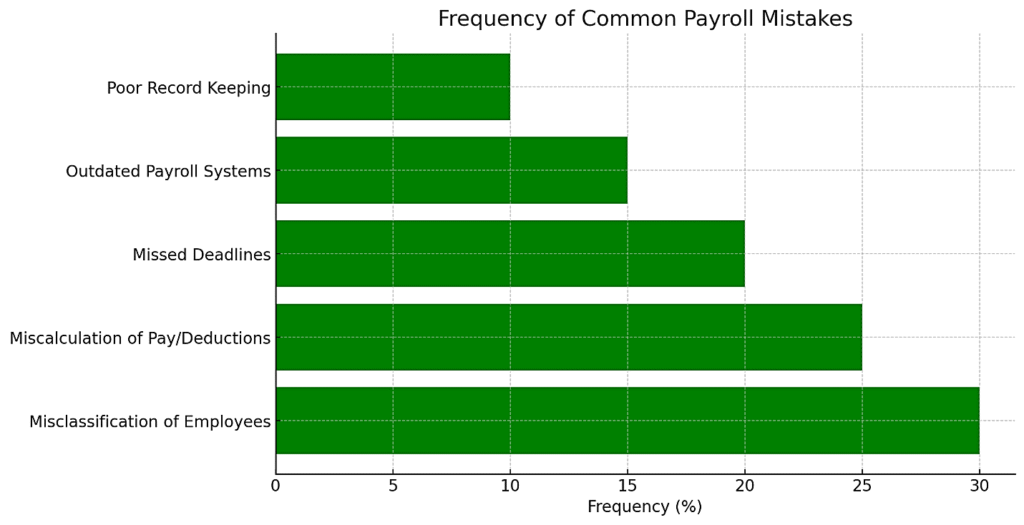
The most common payroll mistakes include misclassifying employees, miscalculating pay and deductions, missing payroll deadlines, using outdated software, and failing to keep accurate records.
2. How can I prevent payroll errors?
Prevent payroll errors by automating payroll processes, maintaining up-to-date employee data, setting regular payroll audits, and choosing the right payroll software or outsourcing partner.
3. How often should I audit payroll?
It’s recommended to audit payroll at least quarterly to catch errors early, but a monthly audit is ideal, especially for businesses with many employees or complex payroll systems.
4. What happens if I make a payroll mistake?
If you make a payroll mistake, correct it as soon as possible, notify the affected employee, and adjust the payment in the next payroll cycle or through an off-cycle payment.
5. Should I outsource payroll or handle it in-house?
Outsourcing payroll can be a good option if you want to reduce errors, stay compliant with local regulations, or free up your HR team. If you have a small team with simple payroll needs, managing it in-house might be sufficient.
Contact us today for a free payroll audit or to learn how we can help transform your payroll process. Let’s make payday the best day of the month!
