

Business compliance refers to fulfilling all legal, tax, financial, and regulatory obligations a business must meet to operate legitimately. In Pakistan, this involves registering with authorities like the Federal Board of Revenue (FBR), obtaining necessary tax IDs, filing accurate tax returns on time, maintaining accounting records, complying with corporate reporting (for companies), and adhering to statutory requirements like withholding tax and sales tax filings. Proper compliance not only keeps your business on the right side of the law but also strengthens credibility with clients, facilitates smoother tax planning, reduces risk of penalties, and enables growth.
What Is Compliance in Business: An Overview
Business compliance is at its simplest the act of adhering to laws, regulations, standards, and policies that are relevant to business practices. It includes:
- Laws: Adherence to the relevant licenses and permits.
- Corporate compliance: Meeting the statutory reporting and governance.
- Tax compliance: FBR laws Tax filings and payments which are accurate.
- Operational compliance: Adherence to the labor, safety, and industry standards.
- Financial compliance: Records keeping and financial reporting.
In Pakistan, compliance is not an option it is a well-organized requirement by both federal and provincial governments to equalize the manner in which enterprises conduct their operations, pay taxes and report their activities.
How Is Business Compliance Connected to Tax Operations
Tax compliance is an important element of business compliance in any business venturing in Pakistan. As the Federal Board of Revenue (FBR) enforces revenue laws, the federal body charged with collection and enforcement of taxes in terms of meeting small business compliance requirements critical to working within the law.
Tax compliance guarantees your business:
- Filing of income tax and other returns is correct and timely.
- Remits taxes (income tax, sales tax, withholding tax etc.)
- Keeps records which can withstand audit reviews.
- Eschews fines and legal liabilities.
It is not merely to get returns filed but to develop systems and practices that ensure compliance continues, the risks are minimized and a credible operation is established.
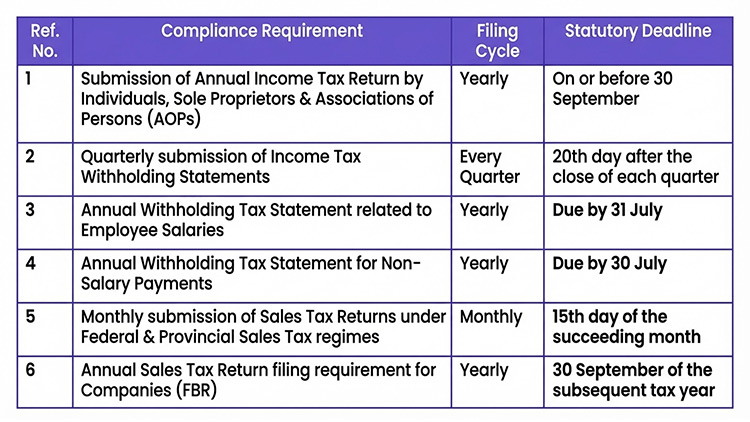
Business Tax Compliance Schedule in Pakistan
To help businesses stay on track, the table below summarizes the most common tax compliance obligations and statutory deadlines applicable in Pakistan.
Who Regulates Business and Tax Compliance in Pakistan: Small Business Compliance Guide
Federal Board of Revenue (FBR)
The FBR is Pakistan’s primary authority for tax laws, responsible for collecting income tax, sales tax, customs duties, and regulating compliance.
FBR’s Inland Revenue Service (IRS)
Within the FBR, the IRS handles income tax, sales tax, and compliance enforcement, including registering taxpayers and managing compliance risk systems.
Federal Tax Ombudsman (FTO)
An independent body that addresses complaints against tax authorities, helping taxpayers resolve disputes and contact expert business compliance services.
Provincial Tax Authorities
Authorities like the Sindh Revenue Board and Punjab Revenue Authority regulate sales tax on services within their jurisdictions.
SECP for Companies
If your business is a company, you also comply with the Securities and Exchange Commission of Pakistan (SECP) for corporate filings and governance.
Comprehensive business compliance, tax, and accounting solutions tailored for your growth explore expert solutions at Finance Ora services for accounting and compliance.
What Are the Main Compliance Requirements for Businesses in Pakistan
Register for Tax and Get an NTN
All businesses must register with the FBR to obtain a National Tax Number (NTN) before they can file taxes. Registration requires basic business details like name, address, and principal activity.
File Income Tax Returns
Businesses, including companies, sole proprietors, and partnerships, must file income tax returns annually through the FBR’s online portal (IRIS). Companies are required to file regardless of whether they have taxable income.
Sales Tax Registration & Filing
If your business sells goods or provides taxable services, you must register for sales tax with the FBR and file monthly returns online.
Withholding Tax Compliance
Withholding tax (WHT) is deducted at the source on certain payments and must be reported and paid to FBR regularly.
Maintain Records
Businesses must keep financial and accounting records, tax invoices, and supporting documents for several years (usually at least six).
SECP Filings (For Companies)
Companies must file annual returns, audited accounts, and other statutory documents with SECP is one of the benefits of compliance in business.
Read our guide on how to register and use your Tax Identification Number (NTN) in Pakistan for compliance and tax operations
Small Business Compliance Checklist in Pakistan Includes:
| Compliance Category | What It Covers | Responsible Authority | Frequency / Deadline |
| NTN Registration | Taxpayer identity setup | FBR | Before operation |
| Income Tax Returns | Annual income tax | FBR | Annually |
| Sales Tax Registration | Register for sales tax | FBR | Before trading |
| Sales Tax Returns | Monthly e-filing | FBR | Monthly |
| Withholding Tax Statements | Deducted tax reporting | FBR | Periodic |
| SECP Annual Filings | Corporate records | SECP | Annually |
| Accounting Records | Maintain books | FBR & SECP | Ongoing |
What Types of Compliance in Businesses are commonly known
- Legal Compliance: Having a business compliance that is under proper registrations, trade licenses, and permits.
- Tax Compliance: Paying of tax like income tax, sales tax, withholding tax and any other federal or provincial tax.
- Corporate Compliance (To Companies): Business development through legal compliance Governing, reporting, record keeping and submission to SECP.
- Operational Compliance: Adhering to labor regulations, safety regulations and industry regulations with reliable compliance business process outsourcing.
- Financial Compliance: Correct bookkeeping, auditing (where needed) and reconciliations relating to tax filings.
Importance of Tax Compliance for your Business Operation in Pakistan
Avoid Penalties & Legal Trouble
Failure to comply with the tax regulations may result in penalties, fines and interest as stipulated in the FBR tax laws. Indeed, as an example, non-filing of business compliance statement or returns required may attract monetary fines or increased tax determination.
Keep Business Credibility
The clients, partners and financial institutions like banks favor a business that is compliant and transparent in its tax and financial business continuity regulatory compliance activities.
Enable Better Planning & Growth
By not only adhering to tax laws, you design the trustworthy financial records which are used to assist in forecasting and business compliance strategies.
Improve Access to Loans & Investors
Financing is usually not done without audited financials and evidence of tax compliance by the banks and investors.
What Are the Common Tax Compliance Challenges to watch out for
Complex Tax Laws & Frequent Updates
Pakistan’s small business accounting compliance tax laws and regulations change frequently, requiring ongoing awareness and adjustments.
Multiple Filing Deadlines
Income tax, sales tax, withholding tax, and other returns have separate deadlines for business continuity compliance.
Registration Variations
Different business types (sole proprietors, partnerships, companies) have specific compliance formats and requirements.
Digital Adoption & Technology
While systems like business cross-border tax compliance the FBR’s IRIS portal simplify filings, they require digital literacy and accurate data entry.
How to Ensure Effective and Ongoing Tax Compliance for Your Bussiness
Organize Your Books & Records: Consistent bookkeeping makes tax filing easier and reduces errors.
Use Online Filing Systems: Register and file returns via FBR’s IRIS to meet deadlines efficiently.
Conduct Internal Compliance Reviews: Quarterly checks ensure nothing is missed before official deadlines.
Train Your Team: Educate staff on compliance basics and responsibilities for your business compliance solutions.
Partner with Professionals: Compliance consultants and tax advisors can handle filings, updates, and communication with authorities.
What Happens If You Don’t Comply and to Avoid Penalties
Non-compliance can result in:
- Monetary penalties and interest charges
- Increased audit frequency
- Legal notices or sanctions
- Loss of business credibility
- Difficulty obtaining loans and contracts
Penalties vary depending on the type of violation, such as late filing, inaccurate reporting, or failure to maintain records.
Conclusion: A Strategic Advantage for Your Business
Pakistan Business and tax compliance is not merely an administrative process that they use to establish scalable operations that are sustainable and trusted. Since registering with FBR and submitting returns on time to having strong accounting systems, compliance is a way to ensure that your business is safe, builds a better image, and opens up more opportunities.
At Finance Ora, we focus on ensuring that businesses remain within the regulations of taxation, prevent penalties and facilitation of their financial processes so that you can grow your business without any concerns.
FAQs
1. What is what is compliance of business operations?
Business compliance refers to the compliance with all the legal, corporate, and tax obligations of a business that are stipulated by law in order to conduct a business in a responsible and legal manner.
2. Do all businesses in Pakistan need to file tax returns?
Yes, all small business compliance department registered brands, with or without profits, should submit annual tax returns to FBR.
3. Can non-filing of tax returns result in penalties?
Yes, not filing returns, keeping records and adherence to business tax compliance notices may attract penalties and fines.
4. What is the role of FBR in compliance?
FBR is in charge of management of tax laws, registration, collection, and compliance enforcement in the whole of Pakistan.
5. Should I hire a professional for compliance?
Using the services of a tax professional will help to avoid mistakes, save time, and make sure that your business gets all the regulatory requirements right.
